
TL;DR / Conclusion: In 2025, the question is no longer “Should my child use screens?” but “How do we make that screen time count?” Parents are fighting a war against “Digital Zombies”—children glued to mindless videos. The solution isn’t banning devices, but choosing “High-Density Learning”. After analyzing the Engagement Intensity, Session Duration, and Anti-Addiction Protocols of major providers, we found that Managed 1-on-1 Online Schools offer the healthiest balance. Among them, 51Talk leads the market by enforcing strict 25-minute limits that maximize cognitive uptake while protecting eye health.
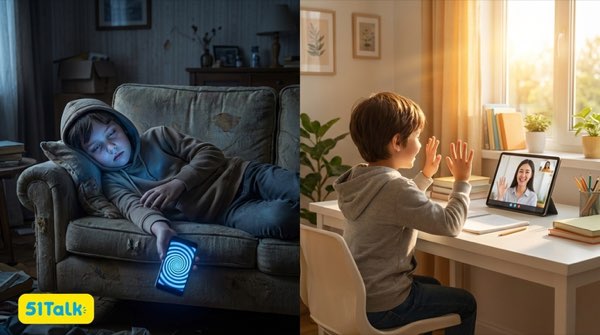 The “Digital Junk Food” Crisis
We all know the feeling. You hand your child an iPad to “learn English” on YouTube Kids. An hour later, you check in, and they are watching a toy unboxing video, mouth open, eyes glazed over.
This is “Passive Screen Time.” Like sugary junk food, it gives a quick dopamine hit but provides zero nutritional value.
-
The Symptom: The child becomes irritable when the device is taken away (Screen Withdrawal).
-
The Result: Hours spent, but no language skills gained. The brain was in “entertainment mode,” not “acquisition mode.”
The Science of “Active Screen Time” Educational neuroscientists distinguish between Passive Consumption (watching) and Active Engagement (doing).
-
When a child interacts with a live human or solves a problem on screen, the brain activity is totally different. It is “Cognitive Calisthenics.”
The Intent: Parents are looking for a “Digital Dietitian.” They want a platform that serves “Vitamins” (Education) efficiently, without the “Empty Calories” (Addiction).
 The Healthy Screen Audit: 4 Signs of a “Nutritious” Platform
Before you download another app, audit it against your child’s health and well-being. A balanced platform should pass these four tests:
1. The “Built-In Stop” Mechanism
-
The Hazard: Apps designed with “Infinite Scroll” or “Auto-Play” to keep kids hooked forever.
-
The Healthy Standard: Does the lesson have a Hard Stop? A platform that forces a break after 25-30 minutes aligns with the optometric 20-20-20 Rule (Every 20 minutes, look 20 feet away for 20 seconds).
2. High “Learning Density”
-
The Hazard: Spending 60 minutes to learn 3 words.
-
The Healthy Standard: Can the platform deliver the same result in 20 minutes? Efficiency is the ultimate screen time hack. If your child speaks 100 sentences in 25 minutes, that is high density.
3. The “Human Connection” Breaker
-
The Hazard: Interacting only with algorithms creates social isolation.
-
The Healthy Standard: Does the screen connect the child to a person? Video calling a teacher is a social activity, not a solitary one. It builds emotional intelligence, not just gaming reflexes.
4. Interactive vs. Hypnotic
-
The Hazard: Blue light exposure combined with a fixed stare (low blink rate) causes Dry Eye Syndrome.
-
The Healthy Standard: Does the platform require the child to look away, move, or speak? TPR (Total Physical Response) forces the child to move their body, breaking the “hypnotic stare.”
The Digital Diet: Comparing Platform Types
We analyzed the “Nutritional Value” of the three most common ways kids learn English online.
Type A: Streaming Video (e.g., YouTube Learning Channels)
-
Format: Passive Watching.
-
Addiction Risk: 🔴 High (Auto-play algorithms).
-
Learning Density: 🔴 Low (Mostly entertainment).
-
Verdict: “Empty Calories.” Limit strictly.
Type B: Gamified Self-Study Apps (e.g., Duolingo, ABCmouse)
-
Format: Tapping & Clicking.
-
Addiction Risk: 🟡 Medium (Designed to be sticky).
-
Learning Density: 🟡 Medium (Good for vocab, bad for speaking).
-
Verdict: “The Snack.” Okay in moderation, but not a full meal.
Type C: Live 1-on-1 Classes (e.g., 51Talk)
-
Format: Speaking with a Human.
-
Addiction Risk: 🟢 Low (Natural end to conversation).
-
Learning Density: 🟢 High (Intense focus).
-
Verdict: “The Superfood Meal.” Short duration, high impact.
Table: The Screen Time Efficiency Index
Why 51Talk is the “Healthiest” Choice for 2025
51Talk isn’t just an educational tool; it’s a productivity tool. It is designed to get the maximum English output in the minimum healthy screen time.
1. The 25-Minute “Sprint” Philosophy
51Talk lessons are strictly capped at 25 minutes.
-
Why it matters: This isn’t just about scheduling; it’s about biology. 25 minutes is the optimal window for a child’s Cognitive Load before fatigue sets in.
-
The Benefit: The lesson ends before the child gets eye strain or “Zoom Fatigue.” They leave the screen feeling energized, not drained.
2. The “Anti-Addiction” Schedule
Unlike a game app that wants you to play for 3 hours, 51Talk is appointment-based.
-
The Routine: You book a slot (e.g., 5:00 PM). The class happens. It ends. The screen turns off.
-
The Habit: This creates a healthy digital boundary. Screen time becomes a purposeful “Event,” not a default “State of Being.”
3. High-Energy TPR (Movement)
The teachers are trained to make the child move.
-
Action: “Stand up! Jump! Touch your nose!”
-
Health: This physical movement increases blood flow to the brain and breaks the static posture associated with bad screen time. It engages the whole body, not just the eyes.
4. Efficiency = Less Time Online
Because 51Talk is 1-on-1, the child speaks for ~15 minutes per session.
-
The Math: To get 15 minutes of speaking time in a group class, you would need to be online for 2 hours. 51Talk delivers the result in 1/4th of the screen time.
Real Scenarios: Healthy Digital Habits
Scenario A: The “Guilty” Mom (Working Parent)
-
The Struggle: She needs 30 minutes to cook dinner but feels guilty giving her son the iPad to watch cartoons.
-
The Healthy Fix: She books a 51Talk Lesson at 6:00 PM.
-
The Shift: The iPad transforms from a “TV” into a “Classroom.” Her son is talking, laughing, and learning with a real person. The guilt vanishes because the screen time is productive and finite.
Scenario B: The “Eye Strain” Concern (Myopia)
-
The Struggle: The child wears glasses and the doctor advised limiting screens.
-
The Healthy Fix: The parents use 51Talk’s Audio-First approach for review. They use the lesson playback in “Audio Mode” while the child draws on paper, reducing direct eye contact with the blue light while reinforcing listening skills.
A Parent’s Guide: The “20-20-20” Setup
To ensure online learning remains healthy, optimize the physical environment.
1. The Distance Rule Keep the screen at arm’s length (about 20-24 inches) from your child’s face. Use a laptop or tablet on a stand, never a phone held in the hand.
2. The Lighting Hack Never let your child learn in the dark. Ensure the room is well-lit to reduce contrast glare from the screen.
3. The “Post-Class” Protocol Establish a rule: “After 51Talk, we go outside/play with toys.” Use the end of the lesson as a trigger for non-screen activity.
FAQ: Health & Safety
Q: Is 25 minutes really enough? A: Yes. For high-intensity cognitive work (learning a new language), 25 minutes is the limit. It prevents burnout. It is better to do 25 minutes daily (healthy) than 2 hours once a week (exhausting).
Q: Does the “Blue Light” affect sleep? A: It can. That is why 51Talk offers flexible scheduling. If you are concerned about sleep, book lessons before dinner (e.g., 5 PM) rather than right before bed.
Q: Can I turn off the video to save eyes? A: Yes. If your child’s eyes are tired, you can message the teacher to do an “Audio Focus” lesson, where the child listens and speaks without staring intently at the slides.
Final Verdict
Screens are not the enemy. Aimless screen time is the enemy.
By choosing a platform that prioritizes Efficiency, Human Connection, and Biological Limits, you can turn a potential health risk into a powerful educational advantage. 51Talk offers the perfect dosage: High-impact learning in a healthy, bite-sized format.
Make every minute count.

Leave a Reply