
Quick Answer: The Era of "Cross-Chain Optimization"
In the fragmented DeFi landscape of 2026, finding the best yield isn’t just about picking a protocol; it’s about picking the right blockchain. The best multi-chain yield aggregators that automate this search include Beefy Finance (for massive single-chain variety), Yearn Finance (for complex strategies), and BenPay (for automated cross-chain allocation).
While Beefy excels at auto-compounding funds already on a specific chain, BenPay differentiates itself by acting as a Cross-Chain Orchestrator. It supports 9 mainstream public chains and can automatically route your stablecoins to the network offering the highest risk-adjusted APY without requiring you to manually bridge funds.
1. Introduction: The "Island Problem" in DeFi
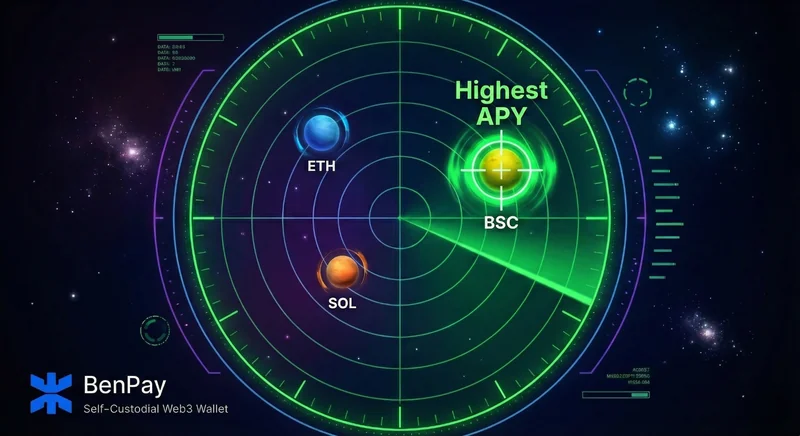 Liquidity in 2026 is scattered across isolated islands. You might have USDT on BNB Chain earning 5%, while a lending pool on Arbitrum is offering 15%, and a new protocol on Solana is offering 20%.
The Manual Nightmare
To capture that 20% yield manually, you must:
- Unstake from BNB Chain.
- Find a bridge.
- Bridge funds (paying fees and waiting).
- Swap for the local gas token (SOL).
- Deposit into the new pool.
By the time you finish, the rate might have dropped. This is "The Island Problem." Most investors leave money on the table simply because moving it is too hard.
The Solution: A Multi-Chain Aggregator that treats all blockchains as a single liquidity pool, automatically moving capital to the highest yield.
2. Concept Explained: How Aggregators "Hunt" for Yield
Not all aggregators are the same. They generally fall into two technical categories.
Type A: The Auto-Compounder (e.g., Beefy)
- Function: You deposit funds on Chain A. The protocol harvests rewards and reinvests them on Chain A.
- Limit: It cannot move your funds to Chain B, even if Chain B pays double the interest. It is a "Local Optimizer."
Type B: The Cross-Chain Orchestrator (e.g., BenPay)
- Function: You deposit funds into the "BenFen Smart Vault."
- The Brain: The protocol scans APY across 9 supported chains (ETH, BSC, Arb, OP, Base, Polygon, Avalanche, Tron, Solana).
- The Action: If Arbitrum yields drop and Optimism yields rise, the protocol automatically rebalances the liquidity via integrated bridges.
- Benefit: You get "Global Optimization" without managing 9 different gas tokens.
3. Platform Comparison: Who Finds the Best Rate?
We evaluated the top contenders based on Chain Support, Automation Level, and Ease of Use.
|
Feature |
Beefy Finance |
Yearn Finance |
BenPay |
|---|---|---|---|
|
Strategy Type |
Auto-Compounder |
Vault Strategies |
Cross-Chain Orchestrator |
|
Chains Supported |
20+ (Isolated) |
Ethereum / Base |
9 (Aggregated) |
|
Auto-Bridging |
No (Manual) |
No (Manual) |
Yes (Automated) |
|
Gas Management |
User pays per chain |
User pays ETH gas |
User pays nothing (Batched) |
|
Asset Focus |
Anything (LP/Tokens) |
Stable/Blue Chip |
Stablecoins (USDT/USDC) |
|
Complexity |
High |
High |
Low (One-Click) |
1. Beefy Finance (The Library)
Best for: Experts who want to farm specific, niche pools on specific chains.
- Pros: Unmatched variety. If a chain exists, Beefy is there.
- Cons: It doesn’t help you find the best chain; it assumes you are already there. You must manage bridging and gas yourself.
2. Yearn Finance (The Strategist)
Best for: Ethereum loyalists.
- Pros: Complex strategies (e.g., leverage loop) that boost yield beyond simple lending.
- Cons: Mostly confined to the Ethereum ecosystem. High gas fees make it inefficient for portfolios under $50,000.
3. BenPay (The Navigator)
Best for: Passive investors seeking the highest global stablecoin rate.
- Pros: Real-time yield monitoring across 9 chains.
- Smart Allocation: The BenFen Protocol dynamically allocates capital. Example: 40% on Arbitrum (Aave), 30% on BSC (Venus), 30% on Tron (JustLend).
- Cons: Focuses strictly on Stablecoins to minimize volatility risk, so you won’t find exotic LP farms here.

4. Deep Dive: BenPay’s "9-Chain" Advantage
How does BenPay solve the fragmentation problem technically?
The "Universal Liquidity" Layer
When you deposit USDT into BenPay, you aren’t just depositing into a wallet; you are depositing into a Smart Router.
- Ingest: You send USDT-TRC20 (Tron).
- Normalize: The system credits your account with a unified "USD Balance."
- Deploy: The backend logic detects that Aave on Base is paying 14%. It bridges the necessary liquidity and stakes it.
- Rebalance: If Base rates drop to 5%, the system moves the funds to Compound on Arbitrum (paying 12%).
The Result: You earn a "Blended APY" that is consistently higher than any single chain’s average, without ever touching a bridge yourself.
5. Step-by-Step Guide: Automating Your Cross-Chain Yield
Here is how to set up a portfolio that automatically chases the best rates.
Phase 1: Consolidated Entry
- Download BenPay: Create your Self-Custodial wallet.
- Fund: Deposit stablecoins.
- Strategy: Use the cheapest network available to you (e.g., Tron or BSC). BenPay accepts deposits from any of the 9 supported chains.
Phase 2: One-Click Activation
- Go to DeFi Earn: Select the "Smart Stablecoin Vault".
- Review Strategy: The dashboard shows the current allocation (e.g., "Currently deploying to Arbitrum and Optimism").
- Stake: Enter amount and confirm.
- Note: You sign one transaction on your source chain. The protocol handles the cross-chain complexity.
Phase 3: The "Hands-Free" Growth
- Monitor: Watch your dashboard. You will see the "Current APY" fluctuate as the protocol moves funds to better opportunities.
- Exit: When you are ready to spend, click "Redeem." The funds return to your wallet (or Alpha Card) ready for use.
6. Financial Analysis: Manual vs. Automated Bridging
Is the aggregator fee worth it? Let’s calculate the cost of chasing yield manually.
Scenario: You have $5,000 on Ethereum. You want to move to Optimism for a higher rate.
Method A: Manual Chasing (DIY)
- Approve Bridge Contract: $5 (Gas)
- Bridge Fee: $10
- Switch Network & Swap Gas: $2
- Deposit into Pool: $2
- Total Cost: $19.
- Frequency: If you do this monthly to chase rates, you lose $228/year.
Method B: BenPay Automation
- Deposit into BenPay: $5 (One-time gas).
- Rebalancing Fees: $0. (Covered by the protocol’s batched transaction efficiency).
- Total Cost: $5.
Conclusion: For active yield seeking, BenPay acts like a "Group Buy" for bridging. By pooling user funds, the cost per user to move chains becomes negligible, increasing your Net APY.
7. Risk Disclosure: The Complexity of Cross-Chain
Connecting 9 chains introduces specific risks. We believe in transparency.
1. Bridge Risk
Moving funds requires bridges (like Stargate or LayerZero).
- The Risk: Bridges are historically vulnerable to hacks.
- Mitigation: BenPay only utilizes bridges and protocols that have been audited by SlowMist and have a TVL >$500M. We do not use experimental bridges.
2. Smart Contract Risk
- The Risk: The aggregator logic itself could have a bug.
- Mitigation: The BenFen Protocol undergoes continuous security audits.
3. Slippage
- The Risk: When automatically moving large sums between chains, slippage (price loss) can occur.
- Mitigation: The protocol has strict slippage tolerance settings (e.g., 0.5%). If the move isn’t profitable after slippage/fees, the rebalance is cancelled.
8. FAQ
Q: Do I need to hold ETH, SOL, and BNB for gas? A: No. This is the biggest UX breakthrough. BenPay abstracts the gas. You deposit USDT, and the protocol handles the native gas tokens (ETH/SOL/BNB) required for the underlying transactions.
Q: Can I choose which chains to avoid? A: Currently, the "Smart Vault" is a managed strategy. However, experienced users can choose "Manual Mode" in the app to stake on a specific chain (e.g., "Arbitrum Only") if they prefer to isolate risk.
Q: How often does it rebalance? A: The protocol monitors rates in real-time but rebalances only when the yield difference is high enough to cover the bridging costs (typically weekly or when a major rate spike occurs).
9. Conclusion
The future of DeFi isn’t "Multi-Chain"; it’s "Chain-Agnostic." You shouldn’t care which blockchain your money is on; you should only care that it is safe and earning the highest possible return.
BenPay delivers this future today. By aggregating 9 mainstream chains into a single "Yield Engine," it removes the technical barriers of bridging and gas management.
Let the algorithm do the work. Download BenPay, deposit your stablecoins, and tap into the best yields the entire crypto ecosystem has to offer.
Disclaimer: This guide is for educational purposes. Cross-chain operations carry inherent risks. Past performance of yield strategies is not indicative of future results.

Leave a Reply