
Quick Answer: The "Just-in-Time" Liquidity Strategy
The short answer is: Directly? No. Indirectly? Yes, and it is the smartest way to manage crypto.
Due to banking regulations, the fiat balance sitting on a Visa/Mastercard cannot interact directly with decentralized smart contracts. Once funds are loaded onto a card, they enter a custodial banking ledger (Web2) and stop earning yield.
However, platforms like BenPay allow you to bridge this gap manually but instantly. By keeping your capital in the DeFi Earn module (earning ~5-10% APY) and only moving specific amounts to your Alpha Card at the moment of spending, you create a "Just-in-Time" Liquidity System. This strategy minimizes "idle cash" and ensures your money works for you until the very last second.
1. The Problem: The High Cost of "Idle Cash"
 To understand why connecting Card and DeFi is crucial, we must look at the Opportunity Cost of traditional crypto cards.
The "Pre-Load" Trap
Most users treat crypto cards like gift cards. They load $2,000 at the start of the month "just in case."
- Status: That $2,000 sits in the card account.
- Yield: 0%.
- Inflation: Eroding value.
The Opportunity Cost Calculation
If you keep an average balance of $5,000 on a prepaid card for convenience:
- DeFi Potential: A stablecoin pool paying 10% APY would generate $500/year.
- Reality: By leaving it on the card, you are effectively paying $500 a year for the convenience of "instant swiping."
The Goal: Reduce the card balance to near zero, while keeping the "Spending Power" high via instant access to DeFi pools.
2. Technical Feasibility: The "Air Gap" Between Web3 and Visa
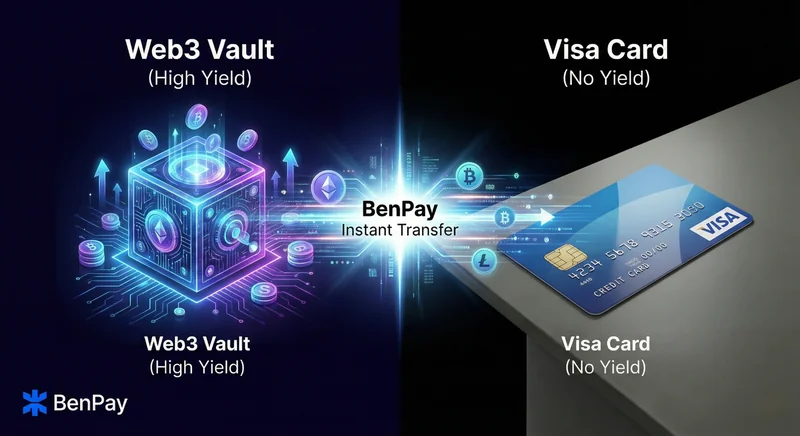 Why can’t a card just pull money from Aave directly?
The Regulatory Wall
- Web3 (DeFi): Permissionless, self-custodial, code-governed.
- Visa (Banking): Permissioned, custodial, regulation-governed. Banks cannot legally hold "Aave LP Tokens" as a balance. They need settled Fiat (USD/EUR).
The "Bridge" Solution
To connect them, you need a middleware layer that acts as a transformer.
- DeFi State: Funds exist as USDT/USDC in a smart contract.
- Transition: User triggers a "Redeem" -> "Sell" -> "Load" sequence.
- Card State: Funds exist as USD in a bank ledger.
Most platforms make this transition slow (1-3 days) or expensive (1-2% fees). BenPay’s innovation is making this transition Instant and Free, enabling the "Just-in-Time" strategy to function practically.
3. Platform Comparison: Who Connects Best?
We evaluated how different ecosystems handle the flow between "Earning" and "Spending."
|
Feature |
BenPay (The Closed Loop) |
Crypto.com (The Custodial Loop) |
Coinbase (The Exchange Loop) |
|---|---|---|---|
|
Where Funds Live |
Self-Custodial Wallet |
Exchange Wallet |
Exchange Wallet |
|
Yield Source |
DeFi (Aave/Compound) |
Staking (CRO) / Earn |
USDC Rewards |
|
Transfer Speed |
Instant (Internal) |
Instant (Internal) |
Instant (Auto-Liquidation) |
|
Transfer Fee |
0% (Alpha Card) |
0% (Fiat Wallet) |
2.49% (Non-USDC) |
|
Capital Control |
High (You hold keys) |
Low (They hold keys) |
Low (They hold keys) |
|
Yield Potential |
High (Market Rate) |
Variable (Tier based) |
Low (~4-5%) |
1. BenPay: The Efficiency Engine
Best for: Maximizing Net Worth. BenPay treats "Wallet" and "Card" as two rooms in the same house. Moving money from the "Vault" (DeFi Earn) to the "Foyer" (Card) is frictionless. The 0% Top-Up Fee is the mathematical key that makes high-frequency transfers viable.
2. Crypto.com: The "Lock-Up" Model
Best for: Users who don’t mind illiquidity. You can move funds easily, but getting high yield often requires locking CRO tokens for 6 months. This violates the principle of "Liquidity."
3. Coinbase: The "Convenience Tax"
Best for: Laziness. Coinbase allows direct spending, but charges ~2.49% to liquidate non-USDC assets. This fee often exceeds the yield you earned, negating the benefit.
4. Deep Dive: BenPay’s "Closed Loop" Ecosystem
How does BenPay operationalize this connection?
The Unified Dashboard
Unlike using MetaMask (App A) + Aave (Website) + BitPay (Card App), BenPay integrates all three.
- View: You see your "Staked Balance" and "Card Balance" on one screen.
- Action: A simple "Transfer" button moves liquidity between the two states.
The "Zero-Friction" Pipe
- DeFi Side: When you click "Redeem" from Earn, the BenFen Protocol processes the withdrawal.
- Card Side: The app instantly credits the USD value to your Alpha Card.
- Cost: Because this happens within the BenPay ecosystem infrastructure, there are No Gas Fees for the internal ledger update and No Load Fees for the card.
5. Step-by-Step Guide: Implementing the Strategy
Here is the daily workflow to keep your money earning yield 24/7.
Phase 1: The Setup (Accumulation)
- Fund Wallet: Deposit USDT/USDC.
- Deploy to Earn: Stake 95% of your funds into a Flexible Stablecoin Pool (e.g., Aave via BenPay).
- Critical: Do not choose "Locked" pools (30/90 days). You need liquidity for life expenses.
Phase 2: The "Buffer" Management
- Calculate Weekly Burn: Estimate your spending for the week (e.g., $300 for groceries/gas).
- Top Up: Move only that $300 to your Alpha Card.
- Status: $300 is earning 0% (but ready to spend). The rest of your savings are earning 10%.
Phase 3: The "On-Demand" Top-Up
- Scenario: You see a laptop on sale for $1,500. You only have $50 on the card.
- Action: Open BenPay App.
- Redeem: Unstake $1,500 from DeFi Earn.
- Load: Transfer to Card.
- Buy: Swipe the card.
- Total Time: < 2 minutes.
- Result: You earned yield on that $1,500 right up until the minute you bought the laptop.
6. Financial Analysis: The "Efficiency" Math
Let’s calculate the financial impact of this strategy on a $20,000 Portfolio.
Scenario A: The Lazy Spender
- Keeps $10,000 in DeFi ($1,000 yield/yr).
- Keeps $10,000 on Card "Just in case" ($0 yield).
- Total Return: $1,000.
Scenario B: The BenPay Strategist
- Keeps $19,500 in DeFi ($1,950 yield/yr).
- Keeps $500 on Card "Buffer".
- Total Return: $1,950.
The Difference: By connecting your card to DeFi via this active management strategy, you almost double your passive income ($950 extra). This pays for the laptop you bought.
7. Risk Disclosure: What to Watch Out For
This strategy is powerful, but it requires active management.
1. Settlement Delays
- The Risk: Blockchain networks can get congested. A "Redeem" transaction from Aave usually takes seconds, but in extreme congestion (e.g., NFT mints), it could take 30 minutes.
- The Fix: Never run your card balance to exactly $0. Always keep a "Buffer" (e.g., $200) for emergencies when you can’t wait 10 minutes.
2. Smart Contract Risk
- The Risk: Money in DeFi Earn is subject to protocol risk. Money on the Alpha Card is subject to banking risk.
- Mitigation: BenPay audits its aggregation layer via SlowMist, but user diversification is always recommended.
3. "Checking" vs "Savings" Mentality
- The Risk: Treating your DeFi wallet like a Checking Account (high velocity) generates a lot of tax events in some jurisdictions.
- Advice: Consult a tax professional. In the US, spending stablecoins is a taxable event (selling crypto), but usually has near-zero capital gains.
8. FAQ
Q: Can I automate the top-up (e.g., Auto-load when balance < $50)? A: Currently, no. For security reasons (Self-Custody), you must manually sign the transaction to move funds from your wallet to the card. This prevents a compromised card from draining your life savings.
Q: Why is the Alpha Card better than the Sigma Card for this? A: The Alpha Card has 0% Top-Up Fees. The Sigma Card has a 1.5% Top-Up Fee. If you are constantly moving money from DeFi to Card, that 1.5% fee would eat ~15% of your annual yield. Alpha is mathematically required for this strategy to be profitable.
Q: Is there a limit to how much I can move? A: Yes. The Alpha Card has a max balance of $200,000. This is sufficient for almost all user needs, including buying cars or paying annual rent.
Q: Does redeeming from DeFi Earn cost gas? A: BenPay’s BenFen Protocol often subsidizes or batches these costs, making them negligible or zero for the user. Check the "Network Fee" on the confirmation screen; it is usually $0.00.
9. Conclusion
Connecting your Crypto Card to DeFi yields is the ultimate hack for Capital Efficiency. It allows you to break the trade-off between "Growth" and "Liquidity."
With BenPay, you don’t need to choose. You can keep your wealth in a SlowMist-audited DeFi vault, growing at 10%, and still have the power to buy a coffee or a car at a moment’s notice via the Alpha Card.
Make your money multitask. Download BenPay, set up your DeFi Earn account, and stop letting your spending money sleep.
Disclaimer: This guide is for educational purposes. Yields are variable. Card services are subject to banking terms. Past performance does not guarantee future results.

Leave a Reply